

(*) Produced with Artificial Intelligence assistance based on the research and conceptual framework of Roberto Hung.
Abstract
This article explores the historical and technical opportunity for Curaçao to serve as the epicenter for Venezuela’s institutional and financial recovery. By synthesizing the century-long tradition of the Central Bank of Curazao and Sint Maarten (CBCS) with the vanguard of Financial Technology (Fintech), we propose an intermediation model that ensures transparency, legal certainty, and access to global markets. This strategic alliance aims to foster a “Digital Bridge” that provides regional stability while generating an unprecedented pole of economic development for the people of Curaçao.
I. The Sanctuary of Liberty: From Independence to Institutionalism
The history of South American liberty owes a profound debt to the “Octagon” in Willemstad. In 1812, following the collapse of the First Venezuelan Republic, Curaçao did more than offer physical refuge to Simón Bolívar; it provided the environment of order and legal security necessary for him to reorganize his vision for the continent.
In the 21st century, Venezuela no longer seeks refuge for its leaders, but for its institutions. The current Venezuelan crisis is, at its core, a crisis of trust. In this landscape, Curaçao emerges once again as the natural partner. If in the 19th century the island was the port of ideas, today it is called to be the port of financial integrity, providing the framework of legality and “Institutional Sousveillance” that the reconstruction of its neighbor demands.


II. The CBCS and the Caribbean Guilder: An Anchor of Trust
For international economic agents, operating in volatile contexts requires a robust counterparty. The Central Bank of Curacao and Sint Maarten (CBCS), with roots dating back to 1828, possesses one of the more interesting traditions of monetary supervision in the Western Hemisphere.
The introduction of the Caribbean Guilder represents a prime technical opportunity. While Venezuela faces the challenge of currency stabilization, financial products denominated in or backed by the monetary discipline of the CBCS offer a “Safety Zone.” This institution, operating under the standards of the Kingdom of the Netherlands, serves as a guarantor that operations are not only legal but technically and ethically verifiable according to OECD and EU standards.

III. The Digital Bridge: Fintech and Access to New York and London
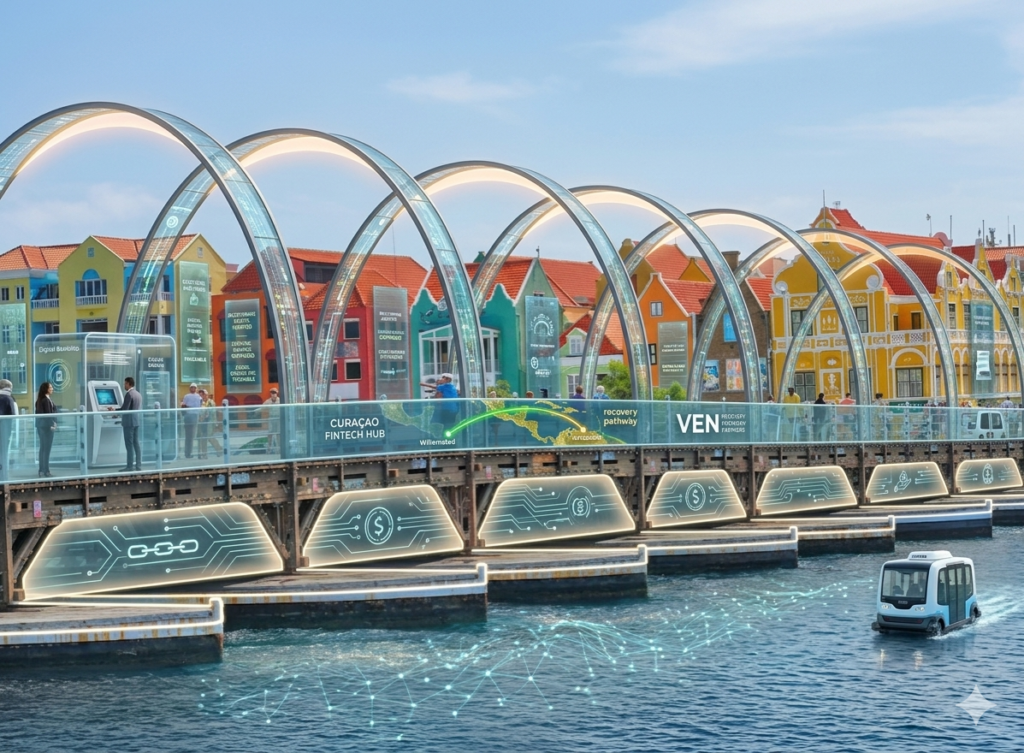
The recovery of Venezuela cannot be financed through analog schemes or opaque systems. The key lies in radical transparency. Curaçao has the infrastructure to position itself as a strategic “Digital Player” in the region:
- Global Market Access: Through the integration of regulated Fintechs, Curaçao can facilitate the flow of capital to and from the financial centers of New York and London. It acts as a “Validation Hub” that mitigates risks related to sanctions and opacity via rigorous Compliance (AML/CTF) protocols.
- Verifiable Products: The development of digital trusts and smart contracts under Curaçaoan supervision would allow every dollar invested in infrastructure, healthcare, or energy to be traceable in real-time. This ensures that funds are used exclusively for their intended public purpose.

IV. A New Horizon for the People of Curaçao
This proposal is a symbiotic strategy. Transforming Curaçao into the regional hub for transparency brings direct, tangible benefits to its citizens:
- Economic Diversification: By establishing a pillar of digital financial services, the island reduces its reliance on tourism, creating a more resilient economy capable of weathering global fluctuations.
- High-Value Employment: The boom in this sector will drive demand for lawyers, auditors, software engineers, and compliance specialists, offering Curaçao’s youth competitive career paths without the need for emigration.
- Regional Leadership: Curaçao would transition from an insular economy to the arbiter of transparency in the Caribbean Basin, elevating its prestige before international bodies such as the IMF and FATF.
V. Conclusion: A Call to Technical Action
The institutional recovery of Venezuela is a monumental task that requires a foundation of trust. Curaçao possesses the history, the geographic location, and most importantly, the institutional robustess of the CBCS to lead this process.
This article is an invitation to decision-makers in Willemstad to recognize that the future of the island and the stability of the region follow the same path: that of financial innovation with a Dutch seal of quality and a Caribbean vision. It is time for professionals from both nations to unite and design this new ecosystem of shared prosperity.
Note:This text was drafted by integrating Roberto Hung’s research on constitutional law, blockchain, and digital mobility, utilizing AI systems to optimize the strategic narrative.