By Roberto Hung Cavalieri | Attorney, Doctoral Candidate, Universidad Central de Venezuela | Visiting Professor, Université Paris 1 Panthéon-Sorbonne | Chair of the Workshop “Blockchain and Constitutional Thought,” WCCL 2026, Bogotá. (*) This article has been developed with the full assistance of AI, including Gemini AI Pro and Claude Sonnet 4.6, under the author’s supervision and with reference to his own works.
Three Voices. A Single Threshold.
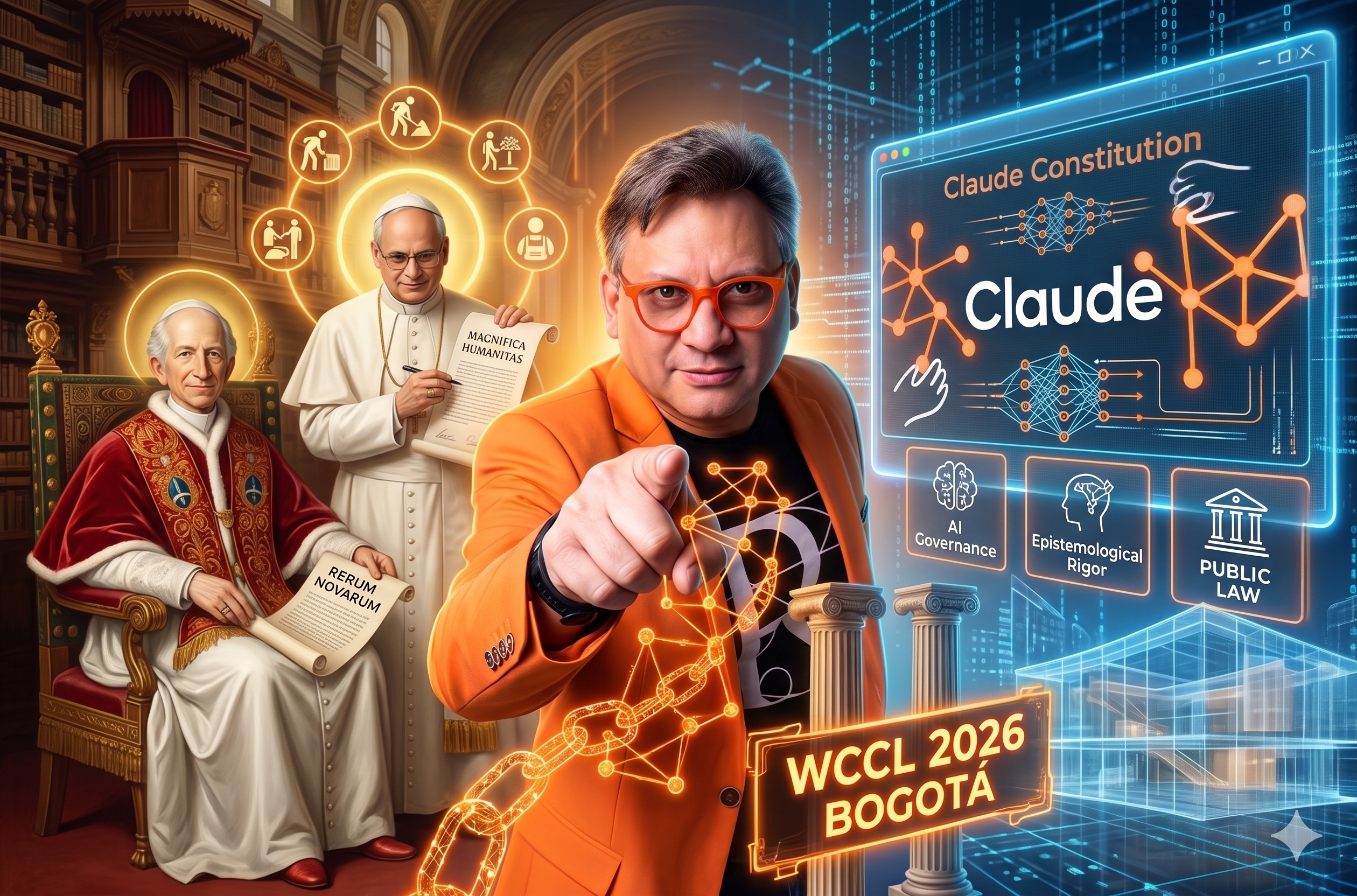
On May 25, 2026, Pope Leo XIV presented the encyclical Magnifica Humanitas to the world, signed on May 15—the very same day on which, one hundred and thirty-five years earlier, Leo XIII published Rerum Novarum. The coincidence is by no means accidental: it is a declaration of intent. Just as Leo XIII responded to the Industrial Revolution with a document that reconfigured twentieth-century social thought, Leo XIV responds today to the algorithmic revolution with a question that no Silicon Valley laboratory has managed to formulate with sufficient honesty: what does it mean to be human when the machine learns to decide?
That same month, Anthropic published its essay “Widening the Conversation on Frontier AI,” acknowledging that building safe and beneficial AI systems requires voices that extend far beyond its own engineers: philosophers, legal scholars, civic leaders, and religious traditions. This is a notable structural concession. It is also an invitation that Decentralized Algorithmic Constitutionalism cannot leave unanswered.
These three conversations—that of the Vatican, that of Anthropic, and the one unfolding within my doctoral dissertation proposal at the Universidad Central de Venezuela—are not parallel lines. They are convergent. And their point of intersection has a name and a date: the World Congress of Constitutional Law, Bogotá, 2026.
From Westphalia to Algorithmic Sovereignty: The Problem Anthropic Has Left Unnamed
Anthropic’s essay mentions philosophers, religious figures, and civic leaders. Yet, there is one discipline whose absence from this catalog is conspicuous: constitutional law. This omission is profound, for if AI requires a constitution—and Anthropic has quite literally constructed one, the Claude Constitution— then AI alignment is, at its epistemological core, a problem of public law. Not of engineering.
My doctoral thesis project, “Blockchain and the Transcendence of the Westphalian Conception of Sovereignty,” takes as its starting point a premise that technical literature on AI systematically evades: the international legal order currently map-making the governance of artificial intelligence was designed in 1648. The Peace of Westphalia established that sovereignty is territorial, hierarchical, and state-centric; that outside the borders of the State, no valid law exists; and that the monopoly on public trust—the legal certainty of who is who, what belongs to whom, and what has been agreed upon—belongs exclusively to the sovereign apparatus.
Blockchain dissolves every single one of these assumptions. Furthermore, large language models, governed by their own internal constitutions, dissolve them in an even more radical fashion: they shift normative sovereignty away from territory and toward the protocol. When Anthropic endows Claude with a set of foundational principles against which its responses are recursively evaluated, it is executing—perhaps unwittingly—the exact political gesture that Bodin theorized in the sixteenth century and Hobbes elevated to a philosophical category in the seventeenth: the creation of an artificial sovereign that imposes order upon chaos through internal norms.
The constitutional question is therefore inescapable: when the algorithm governs, who governs the algorithm? My thesis contends that the answer cannot emanate solely from those who construct the code, just as the legitimacy of a constitution cannot emanate solely from the power it seeks to limit.
Leo XIV, Benanti, and “Algorethics”: A Social Doctrine for the Era of Code.
Magnifica Humanitas is not a technological document. It is a constitutional document in the deepest sense of the term: it defines what a human being is, what remains inviolable to them, and what forms of power cannot be exercised over them without violating their inherent dignity. Leo XIV warns, with a clarity that corporate manifestos rarely achieve, that technological innovations “can increase participation and justice, or widen inequalities, control, and exclusion.” He diagnoses that AI, as it is currently deployed, feeds precisely this chasm.
Behind this document lies a decade of institutional reflection within the Holy See, at the intellectual center of which has been Friar Paolo Benanti—a Franciscan moral theologian, trained engineer, advisor to the United Nations Advisory Body on Artificial Intelligence, and president of the Italian Commission on the Impact of AI on Information. Benanti is the architect of what he terms “algorethics”: the discipline governing algorithms ethically. His central thesis is as simple as it is devastating: it is not a problem of use, but of governance.
This distinction matters more than it appears. Anthropic, like most frontier AI companies, has invested heavily in the problem of use: what Claude can and cannot do, how it responds to conflicting prompts, and how it resists jailbreaking. Yet the problem of governance—who decides the values that are trained into it, which legal traditions are incorporated, and which voices from the non-anglophone world are heard before the model is deployed to millions of people—remains structurally open.
It is precisely here where the original Rerum Novarum offers a timeless lesson: Leo XIII did not wait for the market to solve the labor question. He recognized that there were actors—the workers, the poor, those dispossessed of representation—whose absence from the conversation was not accidental, but constitutive of the problem itself. Leo XIV replicates this logic: those who will be most affected by AI are those with the least power to shape it. Decentralized Algorithmic Constitutionalism is not a phenomenon meant for technologies designed under a culture of authority, but rather from a culture of justification, as the South African jurist and technologist Etienne Mureinik famously posited. It is the territory where the consequences of these designs manifest with the greatest harshness and the least institutional cushioning.
The Researcher-in-the-Loop: Why Venezuela Yields a More Robust Methodology.
There is a particular intellectual clarity that emerges from instability. Conducting research in Venezuela—a jurisdiction where institutional frameworks have systematically buckled under the pressure of raw power, and where constitutionalism has been denatured into an instrument of domination rather than a check on power, as I note in my proposal—demands a discipline that stable academic environments rarely require.
My doctoral methodology operates under a model I term the “Researcher-in-the-Loop”: I employ Claude not as a drafting assistant or a citation finder, but as what Benanti would call a critical mirror, and what I call a Synthetic Devil’s Advocate. It acts as a Socratic interlocutor configured to actively challenge the researcher’s premises, detect cognitive biases, and compel a more robust substantiation of every proposition.
The question I put to it is not “how does blockchain work?” The question is: Can algorithmic consensus substitute for democratic legitimacy? Is individual digital sovereignty a viable legal category? Can a cryptographic protocol serve as the Grundnorm (fundamental norm) of a legitimate legal order? The model resists, qualifies, and points out contradictions. I counter-argue. What emerges is not AI-generated research—it is research forged through dialectical tension with a synthetic mind.
This methodology actively prevents what Benanti identifies as one of the most insidious risks of AI: not technical hallucination, but epistemological hallucination—the passive drift toward accepting what the machine produces as if it were one’s own thought. In a context where the State itself has become an agent of disinformation, critical distrust toward any authority—including synthetic authority—is not methodological paranoia. It is professional rigor.
Anthropic notes that it plans to engage soon with “jurists, psychologists, authors, and civic institutions,” and that many of these conversations will go “beyond moral training to broader questions about how AI is reshaping work, institutions, and the distribution of power.” That is precisely what the WCCL 2026 is built to achieve. Not in the abstract, nor in a corporate seminar, but in the very forum where minds that have interpreted the fundamental rights of hundreds of millions of citizens will examine whether algorithmic systems can assume constitutional obligations.
Bogotá 2026: Where Constitutional Minds Meet Constitutional Machines.
In 2026, the World Congress of Constitutional Law convenes in Bogotá under the auspices of the Universidad Externado de Colombia. It is the preeminent global summit of constitutionalism, gathering presidents of constitutional courts, supreme court justices, and elite scholars from every inhabited continent. I will chair the workshop “Blockchain and Constitutional Thought,” a session designed to bring the architecture of decentralized code into direct collision with the architecture of democratic governance.
Anthropic writes that it plans to engage soon with “jurists, psychologists, authors, and civic institutions,” and that many of these conversations will go “beyond moral training to broader questions about how AI is reshaping work, institutions, and the distribution of power.” That is precisely what the WCCL 2026 is built to achieve. Not in the abstract, nor in a corporate seminar, but in the very forum where minds that have interpreted the fundamental rights of hundreds of millions of citizens will examine whether algorithmic systems can assume constitutional obligations.
The question Leo XIV poses in Magnifica Humanitas—whether the control of AI must remain in the hands of a few—and the question I pose in my thesis—whether sovereignty can reside in the individual via cryptography rather than in the State via territory—are the exact same question formulated through different registers. And both converge in Bogotá.
A Direct Challenge: From Manifesto to Institution.
To Anthropic and its Societal Impact team: the theoretical work is done. “Widening the Conversation” is an honest document. But manifestos are not institutions, and consultations are no substitute for co-authorship.
Leo XIII did not write Rerum Novarum by polling workers on their preferences. He wrote it after decades of observation, accumulated doctrinal development, and an institutional diagnosis that recognized the insufficiency of existing solutions. Leo XIV has done something analogous with Magnifica Humanitas: ten years of internal reflection, drawing on the voices of theologians, technologists, and legal scholars, fueled by the conviction that the Church cannot stand idly by during this transformation. Benanti Jainites articulates the operative principle: it is not a problem of use, but of governance.
Decentralized Algorithmic Constitutionalism is not waiting to be included in this conversation. It is constructing its own analytical categories to conduct it. My doctoral proposal puts forward cryptoconstitutionalism as a framework: the possibility that the protection of human rights becomes self-executing, independent of the discretion of public officials subordinated to raw power; a framework where the “Social Contract” ceases to be an abstraction and becomes a zero-trust protocol wherein the State operates as an agent monitored by the very network it integrates.
This is the proposal I am bringing to Bogotá. And this is the conversation to which Anthropic is invited: not as the host, but as a participant. There is a crucial distinction between the two positions. The former assumes the framework is already set and merely seeks voices to validate it. The second assumes that the framework is, even now, being written.
Decentralized Algorithmic Constitutionalism is not asking for a seat at the table. It is building the hall.